Love tokens in Regency England

About four years ago, my editor found a picture of a Georgian-era coin with one side smoothed and a love poem engraved on it with a bail to turn it into a pendant. She sent it to me and said, “Can you put this in a book??” I had never seen such a thing, but it turns out, these love tokens were popular through the eighteenth and nineteenth centuries. Once I knew that, I HAD to put one in a book.
Love tokens are legal coins that have been deliberately altered by smoothing them on one or both sides and then engraving them. They’ve existed in Britain since the Roman period. The engravings in the Georgian era typically include initials, names, dates, or more intricate designs such as affectionate phrases or pictures. This is typical of the deeply personal and sentimental behavior of the Georgians. Creating and giving these tokens were primarily done within romantic relationships, but they were also gifts between family members and friends.

This inscription on a holed George III halfpenny reads "Dear Mary When this you see think of me when I am far away T G"
Although initials or dates were most common, short poems or romantic lines or drawings were also chosen. Decorative motifs include symbols of sentiment and good fortune, such as flowers and hearts, as well as anchors (hope), lighthouses (safe harbor), horseshoes (luck), and turtledoves (devotion). They could be simple tokens made on impulse by a vendor at a fair for one’s sweetheart, or more elaborately engraved by a jeweler.

This coin was smoothed and engraved on both sides. The obverse says, “No heart so true as mine to you” around a flaming heart pierced diagonally by two arrows. The reverse says “Sweet the love that meets return” around two kissing doves.
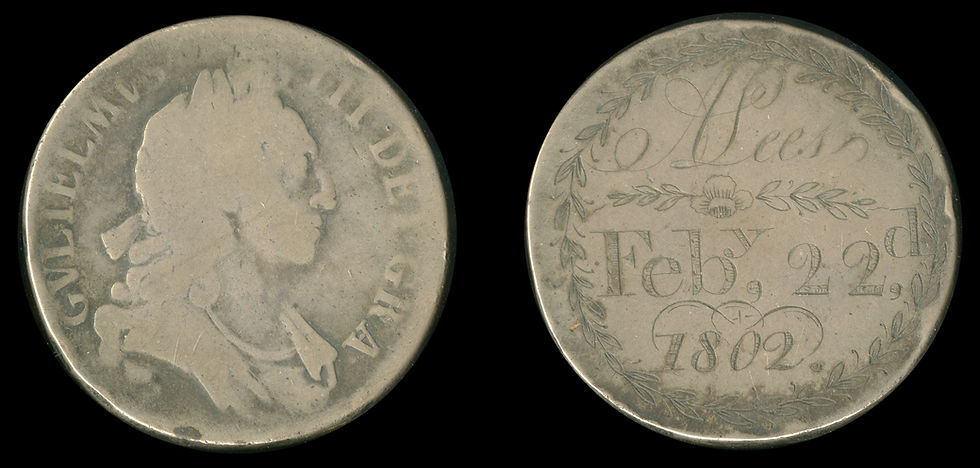
This William III coin was re-engraved a hundred years later with “A Lees Feby, 22d, 1802.”

This token with a damaged hole reads “My heart never will be at Ease Till our hearts and hands be joind like these” above two overlapping hearts and two clasped hands. The obverse says “Health & Love S A” above a hand and a heart.
Love tokens didn’t have to be worn as a pendant. They could have been kept whole and carried close. Sometimes, as a gesture of fidelity, a man might bend a normal or an engraved coin into a crooked coin. Now the coin is bent into an S-shape and could not be used, further demonstrating his devotion as it becomes an amulet one carries with them.


They weren’t always hopeful expressions of engagements, marriages, or births. Convict coins held the same sentimentality, but with affectionate messages gifted to loved ones by convicts awaiting execution or transportation.
This convict coin has a heart pierced by two arrows diagonally with an inscription on either side of the heart. It reads “J B 18 to 33 L B.” On the other is "England Farewell and all I leave behind my Kind Love to My Mother who always did prove Kind."
In Her Affections and Wishes, Darcy has a coin Elizabeth gave him bent into an amulet and has another coin engraved and set to be worn as a necklace. Here’s an excerpt where he gives her the gift. But you’ll have to read the book to see that Darcy chose to engrave on his love token.
“I have something for you. I forgot to give it to you yesterday after your accident. If my asking you to marry me is not proof enough, perhaps this will persuade you that my attraction and love for you is steadfast and of a long duration.”
He handed her a half-crown, with its obverse smoothed and with a hole through it, hanging on a silver chain.
She ran a finger across it as it dangled from his hand. “Was this the half-crown I gave you as payment for my gaming debts?”
“No, I put that specific coin to better use and had it made into something for me.” He drew out that coin that the silversmith bent into a gentle s-shaped curve. “You did not give it to me as a symbol, but I took it as one.”
“You made a love token out of it?” she said with a soft smile. “But now you cannot spend it.”
“That is the point. It proves that I would rather have you than money, a vow to value you above anything else. Besides,” he continued, “I can afford to deface some coins and pay someone to do it because I won at the races yesterday. Octavius won by half a neck and I won thirty guineas at the Derby, and do you know why?”
“You know horses and are skilled at calculating odds?”
He laughed. “No, the jockey wore green, and that is the colour you chose on Tuesday. I told you it was a sound method.”
“A fine strategy,” she said with a laugh. “Now you are a rich man.”
Darcy shook his head. “I am richer this week because I have you in my life, not because of any wagers.”
These love tokens are always unique and are chosen with some care by the giver. They could remember a child’s birth or your wife’s initials. It could remind loved one’s of an absent soldier or a prisoner doing his time. In later Victorian times, young girls collected enough of them from their friends to form a bracelet or necklace. The fad died out as silver was perceived as cheap compared to gold, and photography’s widespread use meant you could carry a loved one’s image, even a small one in a locket next to your heart.
What do you think of these portable and personal reminders of affection? Would you deface a coin to demonstrate your devotion?
© The Trustees of the British Museum. Shared under a Creative Commons Attribution-NonCommercial-ShareAlike 4.0 International (CC BY-NC-SA 4.0) licence.


Comments